
The Blessing Guide

A Blessing Priority Order For Strongest Impact
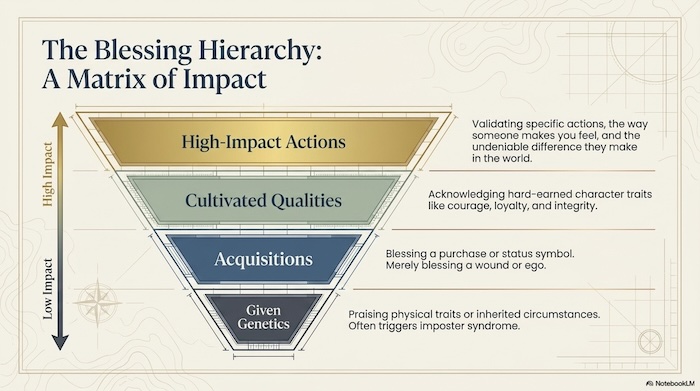
Blessings Priority
As you read the prioritized order of blessings from highest to lowest impact, observe how the first items are much easier for the receiver to accept. In other words, the blessings are more readily received, as they should be.
Impact levels 1-4 are based on a person’s actions, while impact levels 5-7 are based on what a person was given. We don’t have control over what we were given or inherited, but we DO control our actions! Blessing someone based on their actions is far more powerful and better received. Why? We intuitively understand that we did not do anything to earn our genetics or many things we were born with.
Make sure to use the highest level of blessing impact you can. Unfortunately, many of us bless based on things we had no control over, such as what was given to us or what we were born with. What a difference it makes when people bless another person’s differences they have made, or the qualities they have cultivated and the choices they have made.
Read, “Why Blessing Goes Further Than Kindness Or Gratitude” …
High Impact Blessings Based On High-Impact Actions or Cultivated Qualities
#1 — The difference someone has made in your life or that of others
Whether in the past or present, the difference someone makes on others is by far the most significant form of blessing. As people age, they come to realize the importance of their legacy and the positive differences they have made. Here’s a powerful quote that encapsulates this idea:
“Every man has two deaths, when he is buried in the ground and the last time someone says his name.” – Ernest Hemingway. Interestingly, the Egyptians had this saying long before Hemingway.
#2 — How we feel or experience ourselves around another person
This is a reflection of their character and actions. Examples of positive feelings include calmness, inspiration, love, safety, being seen, heard, understood, cared for, and respected.
Sharing our personal experiences and feelings and sense about the person we wish to bless can be incredibly powerful because it’s difficult for them to deny our genuine experience and emotions of them.
the qualities a person cultivates through their choices and actions over time is so worthy of blessing. Examples: devotion, loyalty, courage, integrity, generosity, compassion, dependability, and kindness. Most of our good qualities are often earned, not coming easy. It feels really good to receive a blessing about what we have cultivated.
#3 — Cultivated Inner Qualities
The qualities a person cultivates through their choices and actions over time are truly deserving of blessing. Examples include devotion, loyalty, courage, integrity, generosity, compassion, dependability, and kindness. Most of our positive qualities are earned through hard work and effort, and it is a wonderful feeling to receive a blessing for the qualities we have cultivated.
#4 — What Someone Has Done or Said
What is problematic is blessing someone for an act of purchase or acquiring something, as these usually have a minimal impact. It is far more effective to bless someone for an act or spoken word that had a positive impact on you or others.
For instance, you could say, “I found it inspiring the other day when you shared your story of helping take care of your mother when she broke her leg.” Alternatively, you could say, “I love it when you give your time to Big Brother or stay after work to help out the interns, or when you listen to my challenges with my wife — it always feels good.”
Low Impact Blessings Based On Acquisitions or Genetics
#5 — A purchase or acquisition
Blessing someone for something they purchased might only be a form of blessing a wound. For instance, saying, “I love your great new expensive sports car,” might only be blessing someone for a wounded aspect of their life. They might have bought the expensive car to look and feel more important, get dates, or impress people. I recommend avoiding this approach when you want to increase good in the world.
INSTEAD, BLESS THEM — for the reasons they may have used to buy something. For instance, you could say, “I love the necklace you chose to wear tonight. It complements the dress you picked out, and it looks great on you.” Again, using any of the top three forms of blessing is far more powerful and effective.
#6 — Born into, given or inherited
An individual probably did little to get what they were given, inherited, or born into. Even if they made significant efforts, you probably do not know. For instance, consider a castle or a home inherited from their parents. Instead of simply blessing them for receiving such a gift, it’s more impactful to…
INSTEAD, BLESS THEM — for their accomplishments with what they were given. For example, you could say, “I appreciate that you make your castle available for free every year for the fundraiser.” Alternatively, you could say, “I admire that you purchase your dishes from local artists.” Or, you could say, “I’m grateful that you offer your home to your soccer club buddies for gatherings. It feels wonderful to me when I see you making your home accessible to others.”
#7 — Genetics
Our genetics are not a cultivated quality; we did not earn what we were born with. What makes blessing someone for their genetics even more problematic is that they may not like what they were born with or have some issue, shame, or negative feelings about it, especially because they probably cannot change it.
Additionally, blessing genetics can make many people feel bad because they do many good things in the world but witness people who did nothing receive high praise for something they did not earn or choose!
INSTEAD, BLESS THEM — for a choice they made, such as how they applied their makeup or what they chose to wear that day. Even if they were given those items, they made the choice to apply or wear them that day — they took that action.
Tips To Make Your Blessings Better

A Disastrous Way To Bless
One example is by telling someone you are in a romantic relationship that you appreciate their diligence in doing what you want them to do. Perhaps to an employee of yours, but is this really a blessing? I could provide more examples, but do I really need to? I believe most people instinctively know in their heart (when they bother to check) what constitutes unkind, unpleasant, selfish, passive-aggressive or mean behavior when it is supposed to be kind.
One simple way to gauge whether your words were positive is to observe someone’s non-verbal cues. In fact, consciously pay attention to everyone’s non-verbal behavior — everyone you communicate with — and you might be surprised by how much you miss.
I’m still astounded by how many characters in movies and TV shows overlook or fail to notice the non-verbal responses of other characters. I suspect this is simply poor writing or the result of writers who lack emotional intelligence. You do not have to be an oblivious character like in a movie or TV show! You can easily become more aware of the impact you have on others by observing their non-verbal reactions.
How Often To Bless
The extent of good you want to do depends on your intentions. I realize this may sound a bit cliché, but there’s a kernel of truth in it. If you want to do more good, consider blessing more people.
Blessing demonstrates respect. For instance, I have blessed individuals in some of my men’s groups who were not particularly pleasant to me, and I even expressed my dislike for them. Despite this, I still blessed them. My act of blessing fostered mutual respect between us.
Showing genuine respect is far superior to appeasing people or feigning affection. Even if you don’t like someone, as long as you offer an authentic blessing (you mean what you say), you can earn their respect and make them feel better. It could even lead to a friendship in the future.
Who To Bless
Definitely, those closest to you — parents, siblings, grandparents, children, your significant other(s), and friends. I also enjoy blessing strangers — deli workers, checkout cashiers, airline attendants, healthcare professionals (especially the intake assistants, as they rarely get blessings).
Authentically, I can find at least one thing to bless about most anyone. You can too, you just have to try it!
Blessing Is A Stronger Form of Kindness
Blessing transcends numerous acts of kindness, even though kindness is undeniably needed and wonderful! While kindness is gratifying to receive, blessing goes beyond that by acknowledging some of our deeper truths about our true selves.
We all possess magnificence within our essence, yet we cover it with resistance. Over our lifetimes, layers of resistance accumulate. Blessing helps us recognize our magnificence, even in small ways. Both the giver and receiver of blessing experience increased acceptance and, consequently, greater alignment with their true selves. They begin to remember who they truly are.
So, go ahead and bless away, illuminating our dark world. Humanity desperately needs our light!
Blessing GROUP Exercise
This is a way to make blessing fun, and ensure that everyone gets a turn to both give and receive a blessing.
One person starts by blessing anyone they choose. The person they chose, the receiver, then chooses another person in the group who hasn’t been blessed. They bless that person, and the receiver turns around to choose and bless another group member who hasn’t been blessed. This continues until no one is left.
Occasionally, someone may not receive a blessing. In that case, they can choose whoever they want to bless them or ask who would like to bless them and choose among those volunteers.
People should be blessed for the difference they make, qualities they cultivate, how we experience them, or what they do or say — not for anything they were given, born into, or inherited.
Consider Blessing As A Stewardship
For decades, I have believed that merely helping ourselves is insufficient. In our increasingly divisive world, the stewardship of life on our planet, affectionately and reverently called Gaia, holds greater significance than ever before.
Stewardship now encompasses a responsibility that approaches a duty of care. While I cannot take on a duty of care for everyone, I can certainly do much more than just help myself by outwardly and publicly blessing others.
Bless For A Profound Sense of Wellbeing
Imagine the positive impact of blessing loved ones, family, friends, coworkers, colleagues, and even those you interact with throughout your daily life?
When I practice this, I witness smiles blossom, sparkles shine, and people become more alert. I encourage you to experience this firsthand.
I have observed many of us, including me of course, engaging in various activities to boost our mood. I call most of these activities — dodges, distractions, and diversions—the 3 D’s. Here are some common examples:
- Going to bars and drinking
- Watching shows and movies
- Gossiping
- Having long conversations
- Using drugs (legal and illegal)
- Shopping and more shopping
- Surfing the internet
- Playing video games
- Social media—a significant 3D. It might as well be the one ring to rule them all.
Yet, blessings almost always provide a more profound sense of well-being compared to any of these 3D’s. Moreover, there’s a magical aspect to blessings — their positive impact tends to last longer than most other activities of similar duration.
Be Authentic & Speak From Your Heart
Be authentic in your blessing by speaking from your heart, not what you think the other person wants to hear. This approach helps ensure that your words are genuine and not influenced by any emotional charge or issue you may have.
Say What Is Positive To The Receiver
Ensure that your blessing is positive for the recipient, not what is positive for you, as they can be vastly different.
A real-life example is when I exclaimed, “I could hear your laugh from across the neighborhood!” I made this comment to my father about when he and my mother were at a party. I admired how hearty and jolly his laugh sounded. However, I personally would not want my laughter to be so loud, and I know people who would be mortified if their laughter was so loud.
Support The Receiver To Accept Blessing
A peculiar phenomenon occurs in some of us, though I’m unsure about its cultural specificity. While we can easily bestow blessings, receiving them proves significantly more challenging. Some individuals simply offer a quick “thank you” or engage in self-deprecating remarks, all attempts to dismiss the blessing. Others negate the message by thinking the opposite.
To counteract this counteraction, it’s essential to establish a connection with the recipient. How can this be done? I’ve discovered that maintaining eye contact, smiling, and remaining silent after blessing the recipient significantly enhances their acceptance of the blessing. Furthermore, if you sense or believe that they are dismissing your blessing, perhaps with a muttered “thanks,” try expressing, “Please hear my blessing. I believe you deserve it!”
Amplify By Blessing Publicly
One of the most impactful gifts you can give is to acknowledge someone PUBLICLY. This significantly amplifies the value of any blessing you bestow upon them. You can express your blessings online, where others can witness them (social media), or during group meetings, seminars, workshops, retreats, group outings, gatherings, or team events. The idea is to bless someone in front of an audience, the larger, the better!